Follow SOL from AUD purchase through casino credit and withdrawal, with checks on fees, bonuses, legality, tax and wallet transfers.
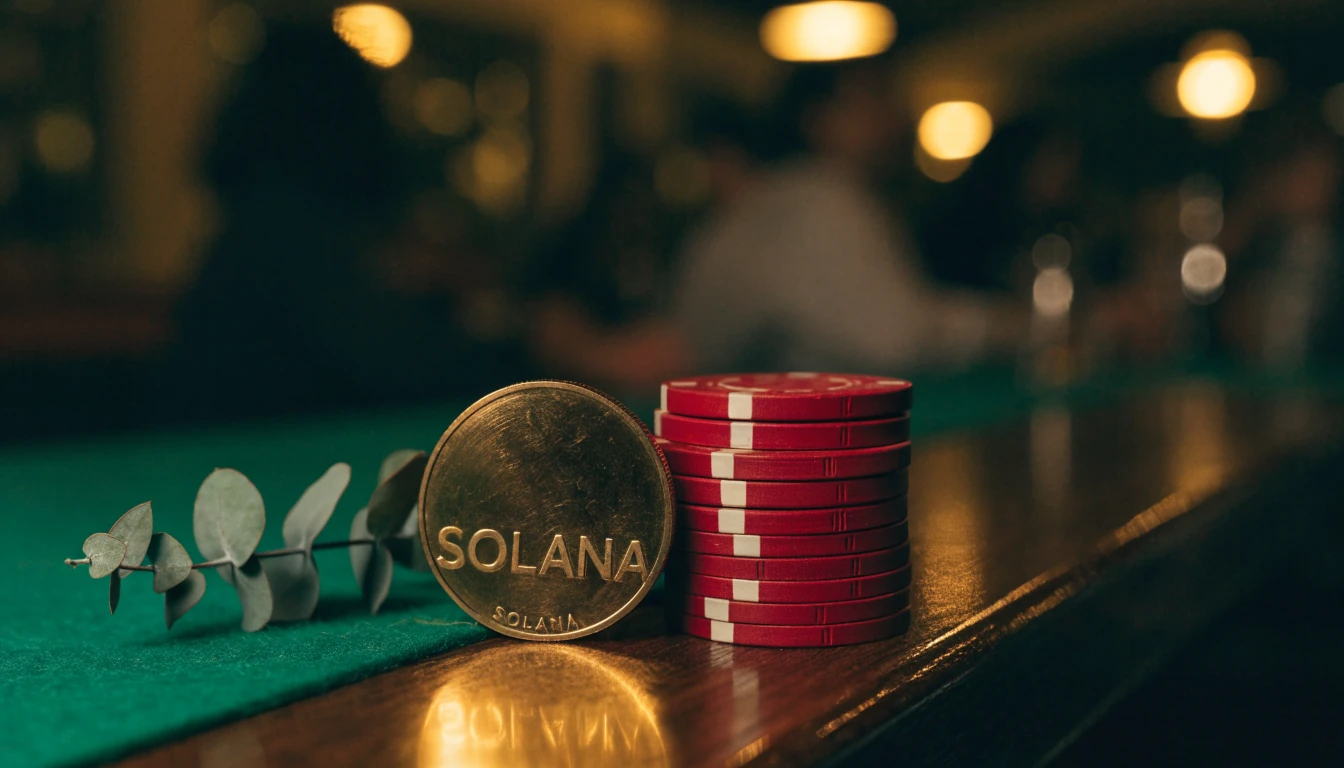
A SOL payment follows a route through separate systems: an Australian exchange converts your AUD into SOL, a wallet sends that SOL to a casino’s deposit address, and the operator credits your account after detecting the transfer. A withdrawal reverses the route, but not as a single transaction. The operator first approves and sends the payment; the Solana network then processes it to your wallet. Each step can affect when funds become available.
Most casinos that accept SOL do not take an AUD bank transfer or card payment directly. You first need to buy SOL through an Australian exchange. Swyftx, CoinSpot and Coinbase AU support AUD deposits by PayID or bank transfer. The exchange may require identity and other checks before you can use its services: on-ramp and off-ramp providers that convert between SOL and AUD are subject to KYC/AML requirements.
Once the AUD arrives, you can place an order to buy SOL. The exchange account and the wallet used to send funds may be separate. If you withdraw SOL from the exchange to a personal wallet first, that adds a transfer and an address to check. If the exchange lets you send directly to the casino, you still need to confirm that the casino accepts deposits from that source and network.
If you’re considering a Solana casino in Australia in 2026, checking each operator’s available licensing and payment details can help you decide what to investigate further. The entries below are a reference point, not confirmation that any operator supports Solana.
Thor Casino
Thor Casino lists a Curaçao licence held by Antillephone N.V. (Versus Odds B.V.). Its minimum deposit is EUR 20.
SpinsUp
SpinsUp lists a Curaçao Gaming Control Board licence, OGL/2023/174/0082, held by Dama N.V.
House of Pokies
House of Pokies lists an international iGaming licence, but the jurisdiction is not named in the source. PayID payouts are listed at 1–24 hours, and the minimum deposit is A$30, or A$10 via PayID.
LevelUp Casino
LevelUp Casino lists a Curaçao eGaming licence, OGL/2023/174/0082, held by Dama N.V. Its minimum deposit is A$15.
Neospin
Neospin lists a Curaçao Gaming Control Board licence, OGL/2023/176/0095, held by Hollycorn N.V.
GoldenCrown
GoldenCrown lists a Curaçao Gaming Control Board licence, OGL/2023/176/0095, held by Hollycorn N.V.
WinSpirit Casino
WinSpirit Casino lists a Curaçao eGaming licence, OGL/2024/923/0383, held by Antillephone N.V. Its minimum deposit is A$30.
SkyCrown
SkyCrown lists a Tobique Gaming Commission licence. Its stated payout speeds are around 10–15 minutes for crypto and 1–5 days for fiat; the minimum deposit is A$30.
Uptown Pokies
Uptown Pokies is listed as operating since 2017 under a Curaçao licence. Its minimum deposit is A$20.
Wild Tokyo
Wild Tokyo lists a Curaçao licence. Its stated payout speeds are 30–60 minutes for crypto and 1–5 days for fiat, with a minimum deposit of A$10.
A casino may display a deposit address or a deposit-specific instruction in your account. Copy the address from the intended deposit page, then compare it with the address shown in your wallet before confirming. SOL transfers are irreversible. If you send funds to the wrong address, they may be permanently lost; neither the exchange nor the casino can be assumed to retrieve them.
After you approve a transfer, your wallet submits it to Solana. A specialist payment review describes network confirmation as taking about 400 milliseconds, with balances updating immediately. That describes the network leg, not a guarantee that the casino will credit your account at the same moment. The operator must detect the transaction and match it to your deposit. Its own systems, account checks or deposit instructions can introduce additional delay.
The amount shown in your casino balance is a credit for play on that service. It is not the same thing as SOL held in your wallet: the operator controls the account ledger, while your wallet controls the assets you hold outside the site. Keep the transaction record, including its status and destination, so you can identify the transfer if the casino balance does not update.
Before sending, read the cash-out terms as well as the deposit instructions. Check how the operator handles withdrawals, what conditions can delay a cashout, and whether additional account checks may apply. Larger withdrawals or bonus cashouts may trigger KYC checks requiring ID verification. Do this preparation before depositing, not only after a win, when a delay or unmet condition can matter more.
To withdraw, you submit a request and provide a Solana-compatible wallet address. The operator may review the request before sending it. Automated operators are reported in a specialist review as processing withdrawals in 5–15 minutes, while manual processes can take up to 72 hours. These are operator processing times, not Solana confirmation times. A specialist platform review also reports that native SOL withdrawals on competent platforms can process within 30–60 seconds; the actual result depends on the casino’s internal processing and network congestion.
After the operator releases the payment, the network sends SOL to the address you supplied. Check that address carefully before submitting the request: an incorrect destination can mean permanent loss, just as with a deposit. Once the transfer is confirmed, the funds should appear in the receiving wallet, although a display or wallet refresh may affect what you see.
If you ultimately want AUD, the process continues through an exchange or another off-ramp. You send SOL to an account or wallet supported by that provider, sell it, and withdraw the AUD using its available method. KYC/AML requirements apply to these conversion services. The AUD you receive depends on the conversion at that time; it is not fixed by the amount of SOL originally deposited.
Legal Risk
Under the Interactive Gambling Act 2001, offshore operators are prohibited from providing online casino games to Australian residents.
These steps describe payment mechanics, not legal approval. Under the Interactive Gambling Act 2001, offshore operators are prohibited from providing online casino games to Australian residents. Offshore services also offer limited consumer protection, with no recourse through Australian authorities if funds are withheld or a platform closes. Using a VPN may lead to account seizure and loss of funds. A quick network transfer does not remove those risks or make an offshore casino legally safe.
A useful comparison separates what a platform claims from what you can verify. A polished interface or a label such as “licensed” does not tell you which authority issued the licence, which company holds it, or whether the licence covers the service offered to Australian residents. Record the legal entity named in the terms, the regulator it identifies and the scope of the stated authorisation. Then check whether those details are consistent across the site’s terms, payment pages and account documents.
That check is not evidence that using the platform is lawful in Australia. The Interactive Gambling Act 2001 prohibits overseas operators from providing online casino services to Australian residents. A foreign licence does not remove that prohibition. Treat licensing disclosures as information about the operator’s claimed oversight, not as a guarantee of Australian legality or a substitute for local consumer protection.
RTP, or return to player, describes a game’s theoretical return over a very large volume of play. It is not a forecast of what you will receive in a session, and it does not guarantee that a particular balance will be returned. When a platform publishes RTP information, check whether it identifies the relevant game and version, and whether the figure is presented as a theoretical value rather than a promise.
Also look for the source of the figure. A statement in promotional copy is harder to assess than information connected to the game’s rules or technical documentation. If the platform does not explain what the figure applies to, you cannot reliably compare it with a clearly defined figure elsewhere. RTP is only one part of the picture: it does not explain withdrawal conditions, bonus restrictions or account checks.
Provably fair tools are intended to let a player check whether a game result was produced consistently with disclosed inputs. The label alone is not enough. Look for an explanation of what data is shown, when it is generated, and how you can use it to verify a result after play. If the platform provides a verification tool, its instructions should make clear which game rounds it covers and what information you need to enter.
A verification process can support confidence in the integrity of particular results, but it does not establish that the operator will process a withdrawal, honour every promotion or resolve an account dispute in your favour. Those are separate questions governed by the platform’s terms and procedures. If the explanation is too vague for you to understand what is being checked, treat the claim as unverified rather than assuming the label answers every trust concern.
KYC checks can require identity documents, and larger withdrawals or bonus cashouts may trigger them. Read the withdrawal and bonus terms before depositing, not after winning. Check what documents may be requested, when a review can occur, how the operator communicates a decision and whether bonus conditions affect withdrawal eligibility. Make sure the account details you provide are accurate and consistent with the payment method you intend to use.
The timing matters. A platform may permit you to deposit and play before completing a check, but that does not mean a later cashout will be automatic. If the terms reserve the right to request documents or hold a withdrawal during review, factor that into your assessment. Do not assume that a fast payment interface means the operator’s internal checks will be equally fast.
A bonus headline does not show how much of the offer you can realistically withdraw. Assess the playthrough requirement, which games count toward it and at what contribution, the time limit, and any maximum cashout cap. These conditions interact: a high contribution rate may reduce the play needed, while a low one can make the same wagering requirement harder to complete. A deadline can further limit whether completion is practical.
Promotional terms should also state whether winnings from bonus funds must be wagered before withdrawal and whether free-spin winnings become bonus funds with separate conditions. Compare the amount you must wager with the amount credited, then account for which play counts and any cap on eligible winnings. The effective value of a bonus depends on all these terms together, not on the advertised amount alone.
A specialist review has reported withdrawal fees imposed by some casinos, ranging from 0.1% to 1% of the withdrawal amount. Treat that as a reported range, not a rule for every platform. Check the operator’s own fee schedule and withdrawal terms to see whether a fee applies, how it is calculated and whether it can change the amount you receive.
A comparison is only useful when each claim has a clear basis: identifiable licensing information, defined RTP disclosures, usable fairness checks, explicit KYC rules and complete promotion terms. If any of those details are missing or contradictory, the uncertainty itself belongs in your assessment.
SOL is legal to buy, hold and transfer in Australia. That does not make every use of it lawful. The Interactive Gambling Act 2001 prohibits overseas operators from providing online casino services to people in Australia. The rule concerns the service being offered, not the currency used to fund it: accepting SOL does not put an online casino outside the Act.
The legal responsibility is directed at the operator. An Australian player is not directly penalised under the Act simply for using an offshore casino, but that does not make the service lawful or the arrangement legally safe. The absence of a prosecution against a player is not approval, and it does not prevent action against an operator or a site from becoming inaccessible.
The Australian Communications and Media Authority (ACMA) enforces the Act, including by blocking access to unlicensed offshore gambling websites. Blocking can interrupt access without resolving a player’s account or payment dispute. A site that loads today may later be blocked; relying on continued access is therefore not a substitute for legal protection.
ACMA’s public Gambling Prohibition Register records unlicensed gambling sites. A specialist review citing the register reported that it contained more than 200 entries in 2026. The register is a record of prohibited services, not a list of approved alternatives. A site’s absence from it should not be read as evidence that the site is authorised to offer casino games in Australia.
ACMA Register
ACMA’s public Gambling Prohibition Register records unlicensed gambling sites, containing more than 200 entries in 2026.
There is also no specific Australian licensing framework for crypto-gambling operators as of mid-2026, according to a specialist market review. A foreign licence, where an operator claims to have one, does not override the Australian prohibition. Nor does using a blockchain payment method create a local licence or a local complaints process.
That gap matters when something goes wrong. If an offshore operator freezes an account, refuses a withdrawal or closes, Australian players do not have the protections or practical recourse that would come from a domestic online-casino regulator. Australian authorities may enforce the prohibition against operators, but they do not provide a routine mechanism for recovering a player’s funds from an offshore casino. Terms published by the operator may describe its own dispute process; they do not create Australian consumer protection.
A VPN does not change the legal position. It may conceal or alter the apparent location used to access a site, but it does not make the operator’s service lawful in Australia. It can also breach the operator’s terms and lead to account restrictions or seized funds. Treat any claim that a VPN makes access safe as a warning sign, not as protection.
For a Solana casino comparison in Australia, separate three questions: whether the operator may offer the service here, whether the player is directly penalised, and what recourse exists if funds are withheld. The answers are not interchangeable. The operator is prohibited from providing online casino services to Australian residents; the Act does not directly penalise the individual player for using one; and Australian authorities do not provide a dependable route to recover money from an offshore platform. Using SOL changes the payment rail, not those legal consequences.
A slot bonus is not automatically withdrawable money. The operator may credit bonus funds to your account, but any winnings generated from those funds must be wagered with real money before you can cash them out. The bonus terms determine what counts as a qualifying bet, how much wagering is required and when the resulting balance becomes eligible for withdrawal.
A wagering multiplier applies to a defined amount, not necessarily to your entire account balance. For instance, a specialist review describes an offer with a 35x requirement on the bonus amount only. That wording matters: the requirement is calculated from the bonus, rather than from the bonus plus your deposit. The same multiplier applied to a larger qualifying amount would require more total betting. Treat a figure reported for a particular offer as that offer’s condition, not as a standard across Solana casino sites.
Free spins can have a separate set of rules. Their winnings may be credited as bonus funds instead of cash, then made subject to their own wagering requirement. A specialist review describes a free-spin condition of 50x. Before accepting spins, check what amount the multiplier applies to and whether their winnings are added to an existing bonus or tracked separately. Otherwise, a balance that appears available for play may still be restricted from withdrawal.
Game contribution affects how quickly qualifying wagering accumulates. Slots typically count at 100% of the stake toward the requirement. A qualifying slot bet therefore adds its full stake to the wagering total. By contrast, blackjack or roulette may count at only 10–20%. A bet on one of those games can add much less toward clearing the same condition, even if the amount wagered is identical. The contribution rate is not a prediction of what you will win; it is an accounting rule for the bonus.
Bonus Calculation
Determine Target
Multiply the bonus amount by the wagering multiplier (e.g., 5 SOL × 40 = 200 SOL).
Apply Contribution
Calculate based on game type; slots usually count 100%, while table games may count only 10–20%.
Reach Total
Continue betting until the credited wagering total reaches the target amount.
This is why a slot machine’s contribution percentage and the bonus multiplier need to be read together. The multiplier sets the target; contribution determines how much of each qualifying stake is credited toward it. If a game is excluded, or its contribution is lower than you assumed, your progress may be slower than the displayed bet total suggests. Bonus rules can also restrict which games qualify, so check the eligible-game wording rather than assuming every slot bet counts.
Read the cash-out terms before depositing or activating an offer. Confirm whether the wagering applies to the bonus, a deposit-and-bonus total, or free-spin winnings; which games count; and what happens when the requirement is incomplete. A balance shown in SOL does not remove these conditions. The casino’s bonus ledger governs whether the funds can be withdrawn, while SOL is simply the asset in which the balance may be represented.
If the terms are unclear about the calculation base or game contribution, do not treat the advertised bonus amount as cash available to withdraw. The practical value depends on the amount you must wager and which bets count toward that total.
Using SOL to fund casino play does not, by itself, make the casino an NFT casino. SOL is a cryptocurrency used as a payment asset; an NFT is a distinct kind of blockchain token. The words may appear together in promotional material, but that does not establish that an NFT is involved in depositing, wagering or withdrawing.
To assess an NFT claim, separate the casino’s payment method from the function said to belong to the NFT. A deposit made in SOL is a transfer of SOL. For an NFT to have a separate role, the operator would need to explain what it does, how a player uses it and what happens if the player does not hold it. Without those details, the label does not tell you whether the NFT changes access to games, records an entitlement or has any effect on an account.
Do not infer a special feature from the fact that a casino uses Solana. The blockchain used for a payment and the assets or features offered by a casino are separate questions. A Solana-based transaction does not prove that the casino issues NFTs, accepts them, or gives them a role in play. Likewise, an NFT mentioned in a promotion does not show that it is required for a SOL deposit.
The distinction matters because a payment option can be described precisely: it identifies the asset accepted to fund an account. A claimed NFT function needs its own explanation. If the terms only say that a casino is “NFT-enabled” or use similar wording, look for an account of the actual mechanism rather than treating the phrase as evidence of a usable benefit. The key point is whether the operator states a concrete function and the conditions attached to it.
A specialist review reports that some casinos accept USDC on Solana as well as SOL. That is another payment option: USDC is a token used to fund play, not evidence that NFTs are integrated into the casino. The presence of more than one Solana-based asset does not change what an NFT would need to do to qualify as a separate feature.
Some casinos accept USDC on Solana as a payment option, which is a token used to fund play and not evidence of NFT integration.
When you encounter the term “Solana NFT casino,” read it as a claim to examine, not as a technical description that explains itself. Check whether the casino distinguishes NFT functions from payment support and sets out any relevant terms. If it does not, you can establish that SOL is accepted as a payment asset, but the NFT wording alone does not tell you what role an NFT has.
A SOL balance has two different values: the number of tokens you hold and what those tokens are worth in Australian dollars. The token count may stay unchanged while its AUD value moves with the market. If you receive winnings in SOL and its price falls before you convert or otherwise use it, those winnings can be worth less in AUD than when you received them. A rise can increase their value. The outcome of the gambling session and the later value of the crypto are therefore separate financial questions.
That distinction matters for tax. Recreational gambling winnings are generally not taxable in Australia. But SOL is treated as an asset for capital gains tax purposes, so profits from gambling with SOL can have a separate CGT consequence. In other words, the general treatment of a recreational win does not automatically settle the tax treatment of the cryptocurrency connected with it. Keep records that let you distinguish the gambling result from changes in the value of your SOL, and get tax advice for your circumstances rather than assuming that every token movement is tax-free.
Losses require care as well. A specialist tax commentary describes gambling losses as offsettable against gains only where the person qualifies as a professional gambler, a classification with a high threshold. Do not assume that a losing session can simply be deducted from a gain or used to cancel a tax outcome. Whether that professional status applies depends on the circumstances, so an individual assessment may be needed.
For a crypto casino using Solana, consider both exposures before treating a displayed balance as money you can rely on in AUD: the gambling outcome may be one thing, while SOL’s market price can change the value of the balance before withdrawal or conversion. Keep transaction and account records, including the value of relevant holdings when you receive or dispose of them. If your activity involves material amounts or repeated transactions, consult a registered tax professional who can assess the details against current Australian tax rules.
In dice-style casino play, SOL is the payment rail: it moves value between a wallet and a casino account. That does not mean each roll is necessarily a separate Solana transaction. The network handles transfers of SOL; the platform handles the play and records activity within its own system. The distinction matters because a low-cost blockchain transfer does not determine how quickly a casino credits a balance or processes a request.
Solana’s average transaction fee is about $0.00025 USD, effectively near-zero for an individual transfer. That fee is paid for network processing, not as a charge for playing. It also does not cover any fee an operator might apply or account for the operator’s internal processing. A dice casino using Solana can therefore have inexpensive network transfers while still delivering a slower overall experience if its own systems take time to update or handle account activity.
The same separation applies when funds leave the platform. The network fee is only one part of the process; an operator’s handling can affect when a withdrawal is sent. Check the cash-out terms before depositing, including any stated processing conditions and possible charges. Larger withdrawals or bonus cash-outs may trigger KYC checks that require identity documents, so a network that confirms transactions quickly does not remove those checks.
SOL transfers are irreversible. Confirm the destination address and network before sending: if you send funds to the wrong address, they may be permanently lost. Do not treat a small network fee as a safety net; it does not make an incorrect transfer recoverable.
There is also an Australian legal boundary. The Interactive Gambling Act 2001 prohibits offshore operators from providing online casino games to Australian residents. The law targets operators rather than directly penalising individual players, but the lack of player penalties does not make offshore use legally safe. If funds are withheld or a platform closes, Australian consumer protection and local authorities do not provide the same recourse as they would for a domestic service. A VPN does not change the legal position and may expose an account and its funds to seizure under an operator’s terms.
The practical point is that Solana’s low transaction cost describes the network, not the whole dice-play experience. Network fees, platform processing, account checks and the legal status of the service are separate considerations; one cannot be inferred from another.
A wagering requirement measures eligible bets, not the amount you must deposit. Game contribution determines how much of each bet counts toward that target. A bet that contributes 100% adds its full value; one that contributes 10% adds only a tenth. The same bonus can therefore require very different amounts of actual play, depending on which games you choose.
Slots generally count fully toward wagering requirements. Table games such as blackjack or roulette may count at only 10–20%. If the terms set a target of 200 SOL in eligible wagering, bets on slots could accumulate that total directly. At a 10% contribution rate, you would need 2,000 SOL in bets to generate the same credited wagering; at 20%, you would need 1,000 SOL. These are totals wagered, not SOL you need to hold at once: the same funds may be wagered repeatedly, although losses can reduce your balance before the target is met.
A specialist review describes a 40x requirement on a 5 SOL bonus. The calculation is 5 multiplied by 40, giving 200 SOL in required bets before withdrawal. That figure is the target under the stated example, not a promise that 200 SOL of play will leave you with a withdrawable balance. Outcomes can reduce your funds while you work through the requirement, and a lower game contribution would increase the actual betting volume needed to reach the credited target.
Check whether the multiplier applies to the bonus alone or to another amount specified in the terms. Then check the contribution rate for each game category and whether particular games are excluded. A headline multiplier on its own cannot tell you how much play is required: the multiplier sets the credited target, while contribution determines how quickly your bets count toward it.
Attention! A lower game contribution rate increases the actual betting volume required to reach the credited wagering target.
Before depositing, read the cash-out conditions, including any game-specific contribution rules and restrictions on bonus winnings. Offshore operators are prohibited under the Interactive Gambling Act 2001 from providing online casino games to Australian residents; this explanation describes the arithmetic, not an endorsement of play.
SOL is a transferable asset, not necessarily a token created by a casino. When a platform accepts it, you send SOL from a compatible wallet to the deposit address it provides. The casino then credits a balance for play. The token’s function is payment: holding or transferring SOL does not, by itself, give you a separate casino feature or special status.
The Solana network charges a fee to process a transaction. Its average fee is about $0.00025 USD per transaction, which is effectively zero for an ordinary transfer. That fee goes to the network, not to the casino. It is separate from any amount the operator may require as a minimum deposit, and a low network fee does not mean the platform has no other payment conditions.
A specialist casino review reports minimum SOL deposits in a range of 0.01 to 0.1 SOL, equivalent to approximately AUD$2.80–$28 at April 2026 prices. Treat that range as a report from that type of source, not a universal rule. A platform sets its own minimum, and a requirement stated in SOL can represent a different Australian-dollar amount as the exchange rate changes. Check the displayed minimum and the currency in which it is set before deciding how much to send.
The distinction between a network fee and a minimum deposit matters when planning a transfer. The fee is charged for processing the transaction; the deposit threshold determines whether the casino credits the payment. Sending less than the stated threshold may leave funds uncredited or require you to contact the operator. Do not assume that the network fee will be deducted from the deposit amount in a particular way: check the wallet and platform instructions.
SOL transfers are irreversible. If you send funds to an incorrect address, the transfer cannot be cancelled and the funds may be permanently lost. Confirm that the platform accepts SOL on the Solana network, and that the address shown is the intended deposit address, before sending. A low transaction fee reduces the network cost of moving funds; it does not reduce the consequences of an address error or guarantee that a casino will credit or return a transfer.
Treat the final confirmation screen as the point of no return. Solana transfers are irreversible: if you send SOL to the wrong address, the funds can be permanently lost. Copy the deposit address from the intended account, then compare the full address shown by your wallet with the one displayed by the casino. A matching start or end is not enough; check the complete string.
Confirm that the asset and network selected in your wallet match the deposit instructions. Do not send a different token to a SOL address, or assume that an address saved from an earlier transaction is still correct. If anything on the casino’s deposit screen conflicts with your wallet, stop and resolve the discrepancy before signing.
Read the cash-out terms before depositing, not after a win. Check whether withdrawals or bonus cashouts can require KYC checks, including ID verification, and understand the conditions attached to funds you may later want to withdraw. A deposit that arrives successfully does not establish that a later cashout will be approved.
There is also a legal and practical risk that an address check cannot solve. Under the Interactive Gambling Act 2001, offshore operators are prohibited from providing online casino games to Australian residents. Using one is not legally safe merely because no player has been prosecuted. If an offshore operator withholds funds or closes, Australian authorities do not provide you with the usual consumer recourse. Using a VPN can also lead to account seizure and loss of funds.
Only sign once the destination, asset, and terms are clear. If you cannot verify any of them, do not send the transfer.
You buy SOL with AUD through an exchange, then send it from a compatible wallet to the casino’s deposit address. For a withdrawal, you request a payout to a Solana-compatible wallet; the casino processes it before the network sends the SOL.
Minimum deposits typically range from 0.01 to 0.1 SOL, approximately AUD $2.80–$28 at April 2026 prices. Check the casino’s deposit terms for its minimum.
You send SOL from your wallet to the casino, which credits your account after detecting the transfer. The casino controls the balance on its platform; withdrawals are requested through the casino and sent to a wallet address you provide.
Automated operators may process withdrawals in 5–15 minutes, while manual processes can take up to 72 hours. After release, native SOL transfers can take about 30–60 seconds on competent platforms; the overall time depends on the casino’s processing and network congestion.
Yes. Some Solana casinos accept USDC on the Solana network as well as SOL.
The Interactive Gambling Act 2001 prohibits overseas operators from providing online casino services to Australian residents. The Act targets operators rather than individual players, but using offshore casinos offers no Australian legal protection if funds are withheld.