Search labels and distance results can point to venues, but they do not confirm gaming-area access, operating machines or current conditions.
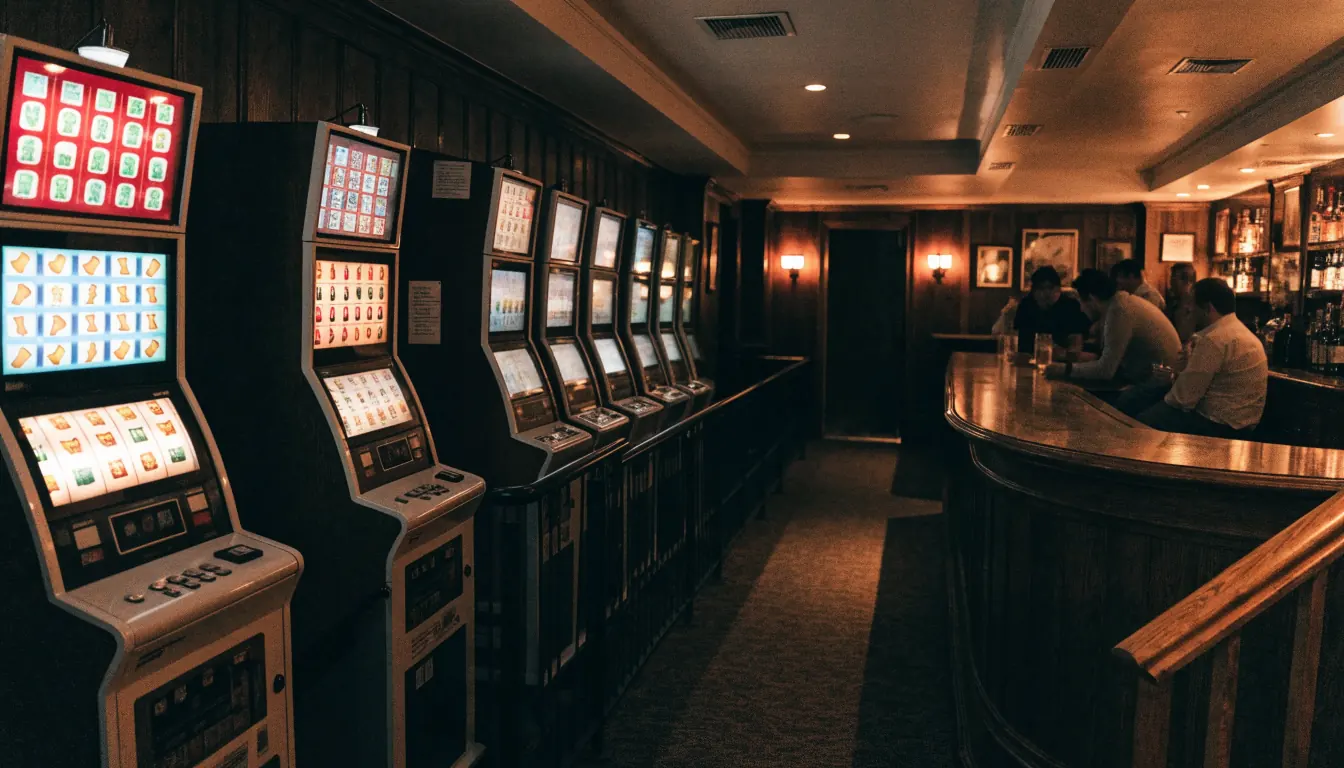
A result marked “open now” is a time-sensitive indication, not confirmation that you can use pokies at that moment. It may reflect a venue’s listed trading hours, but those hours can be outdated or may not describe every part of the premises. A venue could be open while its gaming area is unavailable, or a temporary change could make the published status inaccurate.
That distinction matters when you are deciding whether to travel. “Open” can refer to the venue as a whole: its dining area, bar or other facilities. It does not necessarily establish that the area containing pokies is accessible, that the machines are operating, or that you can enter and play. A listing can help identify a possibility, but it cannot settle those practical questions on its own.
Search results and map listings may draw on information supplied by a venue, information collected from other sources, or schedules that have not been updated to reflect a change. Even when a result appears current, it may not account for a one-off closure, a private function, maintenance, staffing arrangements or a change to access inside the venue.
Choosing pokies to play in Canberra means finding an option that suits your priorities, whether that is a clearly stated minimum deposit or a listed payment timeframe. Use these verdicts as a quick reference when considering your options.
Thor Casino
Thor Casino lists a Curaçao licence held by Versus Odds B.V. and a minimum deposit of EUR 20. Check whether that deposit amount suits you.
SpinsUp
SpinsUp lists a Curaçao Gaming Control Board licence, OGL/2023/174/0082, held by Dama N.V. This gives you a specific licensing detail to consider.
House of Pokies
House of Pokies lists PayID payouts of 1–24 hours and a minimum deposit of A$30, or A$10 when using PayID. Its source describes the licence as international but does not name the jurisdiction.
LevelUp Casino
LevelUp Casino lists a Curaçao eGaming licence, OGL/2023/174/0082, held by Dama N.V., and a minimum deposit of A$15. You can use these details when assessing whether it fits your preferences.
Neospin
Neospin lists a Curaçao Gaming Control Board licence, OGL/2023/176/0095, held by Hollycorn N.V. This licensing information is the available point of reference.
GoldenCrown
GoldenCrown lists a Curaçao Gaming Control Board licence, OGL/2023/176/0095, held by Hollycorn N.V. You can consider this licensing detail as part of your review.
WinSpirit Casino
WinSpirit Casino lists a Curaçao eGaming licence, OGL/2024/923/0383, held by Antillephone N.V., and a minimum deposit of A$30. These details give you a concrete starting point for evaluating it.
SkyCrown
SkyCrown lists a Tobique Gaming Commission licence, a minimum deposit of A$30, and payout estimates of around 10–15 minutes for crypto and 1–5 days for fiat. You can weigh the stated payment options and timings against your needs.
Uptown Pokies
Uptown Pokies lists Curaçao licensing, notes that it has operated since 2017, and sets a minimum deposit of A$20. You can use its stated operating history and deposit threshold as reference points.
Wild Tokyo
Wild Tokyo lists a Curaçao licence and a minimum deposit of A$10. Its stated payout estimates are 30–60 minutes for crypto and 1–5 days for fiat.
The wording can also be broader than it appears. A listing may show that a business is open without specifying which services are available. If you need pokies rather than simply an open venue, the relevant question is not only whether the premises are trading; it is whether the gaming area is open to patrons and machines are available for use.
A result that says a place is closed has similar limits. It may be based on a standard schedule that does not include a special opening arrangement. The label is useful as a prompt to check, but it is not a complete account of what is happening at the venue.
Before setting out, look for information published by the venue itself and check whether it refers to the whole venue or specifically to its gaming area. If the distinction is unclear, contact the venue directly and ask whether patrons can access the pokies now. You can also confirm whether any temporary closure or access restriction applies.
This direct check is more useful than relying on a general “open” indicator because it addresses the service you actually intend to use. If you cannot get confirmation, treat the status as uncertain rather than assuming that a search result guarantees access. That does not mean the venue is closed; it means the available label has not answered the question precisely enough.
A call can still have limits. Conditions may change after you receive an answer, and staff may be able to confirm only the current arrangement. If your plans depend on immediate access, check close to the time you travel rather than treating an earlier result as a continuing promise.
People looking for pokies early or late are trying to establish whether access is possible at a particular point in the day. A broad listing may not give enough detail to answer that. The venue’s general trading schedule might not match the operating schedule for its gaming area, and neither schedule necessarily reflects a temporary change.
Avoid inferring a precise opening time from wording such as “open early” or “open late”. Those phrases are relative, not a confirmed schedule. If a listing gives hours, check what those hours cover and whether the gaming area follows them. Where the information is ambiguous, ask the venue rather than filling in the gap yourself.
The same caution applies when a result appears in response to a search for Canberra pokies open now. The result can help you find a venue to investigate, but it should not be read as a real-time guarantee. A venue’s name, a map pin and an open-status label are separate pieces of information; together, they still may not confirm that pokies are available to you at that moment.
For an immediate visit, useful confirmation is specific: the venue is accessible, its gaming area is open, and patrons can use the pokies at the time you plan to arrive. A general listing may establish none of those points, or only some of them. The more important the trip is to your plans, the more worthwhile it is to verify the details directly.
If you cannot confirm access, keep your decision reversible. Do not treat a search label as a guarantee or make a long trip on that basis alone. The practical value of an “open now” result is that it narrows down what to check next. It does not replace that check, and it does not establish that every service inside the venue is operating.
A pokie’s return percentage and the result of an individual spin describe different things. The return percentage, or RTP, is a setting that describes the game’s theoretical return across play over time. It does not predict what a particular spin will pay, or what you will receive during a short session. A spin is an individual event determined by a Random Number Generator (RNG).
The RNG selects an outcome independently for each spin. A previous win, loss or sequence of results does not make a particular outcome more or less likely on the next spin. A run of losses is not a signal that a win is due, and a recent win does not mean the next spin is less likely to pay. The machine does not need to “balance” its results for one player or one session.
This independence matters when comparing games described as high-return or best-paying. A past result, a story about a large win or a brief personal session cannot establish a game’s RTP. Those observations concern outcomes that have already occurred; RTP is a property of the game’s configured settings, not a forecast for the next player. Even when the game’s theoretical return is known, it cannot tell you the outcome of an individual spin.
The setting itself may also vary between casinos. Some game providers give casinos a choice of RTP configurations for a particular pokie. A specialist review has reported that the same game can therefore operate with different return settings at different casinos. Recognising the game’s name or appearance is not enough to establish which setting applies: you need information about the configuration at the specific location.
That distinction affects how you assess claims about pokies in Canberra. A game’s advertised or published return is useful only if it clearly relates to the version and setting actually in use. General information about a title does not, by itself, show the setting at a particular Canberra venue. Nor does the word “best” establish that a game has a higher return than another one. Without comparable, game-specific setting information, a ranking by expected return cannot be confirmed.
RTP is also not a promise that a player will receive a particular share of their own stakes. It describes a theoretical pattern across play, while your results may differ substantially. If you stop after a short session, the outcomes you experienced do not need to resemble the theoretical return. The RNG does not adjust your result to bring your personal total into line with the published setting.
When you see a return figure, check what it refers to before treating it as a comparison. Is it tied to the exact game, and does the information identify the relevant configuration? If those details are unclear, the figure cannot reliably distinguish one Canberra pokie from another. A game title alone is not enough evidence to call it the best-paying option in the city or CBD.
Attention: A game's theoretical return (RTP) does not predict the outcome of an individual spin or a short session, as each result is determined independently by a Random Number Generator.
The same reasoning applies if you compare a venue game with an online version. The shared title does not prove that the games use the same RTP setting, and the setting does not make their individual outcomes predictable. The mechanics explain what a return figure can describe; they do not identify a winning machine or a reliably profitable session.
In practical terms, treat each spin as a fresh random outcome, and treat RTP as a setting that may differ by casino. Neither recent results nor a game’s reputation can tell you what the next spin will do. A meaningful comparison needs reliable information about the precise configuration in use, rather than a name, a streak or a claim that one game is “hot.”
A person in Canberra is subject to Australian law when accessing real-money online pokies. The Interactive Gambling Act 2001 prohibits companies from providing those services to people in Australia without a domestic licence. No licences for online casinos have been issued, so there is no Australian-licensed online casino.
The distinction is between the operator’s conduct and the player’s. The Act targets companies offering prohibited services, rather than imposing a penalty on an individual merely for playing. Australians may be able to access offshore sites that accept them, but that does not make those sites Australian-licensed or give a player the protections available through a domestic online casino. The legality of the service and the player’s personal liability are separate questions.
The Australian Communications and Media Authority (ACMA) enforces the Act. It also blocks access to illegal offshore gambling sites, with internet service providers required to comply with its blocklist. A site being reachable at a particular time does not establish that it is licensed in Australia, lawful for an operator to offer here, or subject to Australian oversight. Access can also be affected by blocking measures.
There is no domestic online casino licence for you to check when assessing a real-money pokies service. A foreign licence, a polished website, or an offer framed around Canberra does not substitute for Australian authorisation. Nor does a site’s willingness to accept a registration or payment establish that it has local regulatory approval.
This matters when an operator disputes a withdrawal or refuses to pay winnings. If an offshore casino withholds money, Australian players have no legal recourse in Australia against that casino. That risk is different from the question of whether the player has personally broken the law. It concerns the practical ability to enforce a claim against an operator outside the Australian licensing system.
Claims about high betting limits, “best-paying” games, or a no-deposit offer do not change that position. A promotional label cannot create local oversight, and a payment or game feature cannot establish that a service is licensed here. Treat any claim about real-money online pokies as separate from proof of Australian legal protection.
BetStop applies to Australian-licensed operators; it does not bind offshore sites. Since there is no Australian-licensed online casino, do not assume that registering with BetStop will prevent access to an offshore pokies service or stop that service from contacting you. It is not a substitute for checking what an offshore operator can do with your account or how a dispute would be handled.
Legal Risk
No Australian-licensed online casinos exist; using offshore sites means you have no legal recourse in Australia if an operator withholds winnings.
If gambling is causing harm, do not rely on an offshore site to apply Australian protections or honour an Australian exclusion. The same practical caution applies to account controls: a feature displayed on a website is not evidence that an Australian regulator can enforce it.
Canberra wording does not alter these limits. A service described as serving Canberra, or as offering online pokies “near” the city, remains an online service when play takes place over the internet. The relevant issue is not the distance between you and a venue; it is that real-money online casino services are prohibited for operators to provide to people in Australia without a domestic licence, and no such casino licences exist here.
A request for pokies near Canberra Airport expresses a preference for a location, not proof that a venue is inside the airport or nearby. “Near” has no fixed boundary in ordinary use. It might mean a short trip from a terminal, somewhere in the airport district, or simply a place considered convenient while travelling. Those are different requirements, so the wording alone cannot tell you which one the person has in mind.
The distinction between “at the airport” and “near the airport” matters. A venue described as nearby could be outside airport grounds; a venue inside an airport would be a different claim. A map pin or a result title may indicate an approximate area, but it does not establish the venue’s exact entrance, premises or available facilities. If you need a particular kind of location, confirm the address and whether the venue itself matches it rather than treating proximity language as confirmation.
The same principle applies to requests about Canberra Airport without the word “near”. Mentioning the airport may identify a point of reference—perhaps because you are travelling to or from it—rather than a request for a venue within the terminal. The wording does not establish that pokies are available at the airport. It also does not establish that a result is suitable for your route: distance in a straight line can differ from the journey you would actually make.
“Near me” is even more dependent on context. Its intended centre is the person’s current location, not Canberra as a whole. If a device or service uses location information, the area shown may depend on the location it has been given; if it does not, the phrase may be interpreted broadly. A result labelled as close to you should therefore be treated as a starting point for checking the address, not as a verified measurement of travel distance.
CBD wording narrows the intended area to central Canberra, but it does not identify a particular venue or show how close a result is to the centre. Someone may mean a walkable location, a short drive, or simply somewhere within the central district. “North Canberra” likewise points to a broad part of the city, not a precise neighbourhood or address. Without a specific destination or boundary, two people can use these descriptions and mean different areas.
A reference to Victoria introduces a separate ambiguity. It may reflect a mistaken assumption about Canberra’s location, an interest in a broader trip, or a request that combines places in different states. The wording does not establish that a Canberra venue is in Victoria, nor does it identify a cross-border destination. Treat the state name as a clue to clarify the intended area, not as evidence about where a venue is located.
Across all these descriptions, the useful distinction is between a location preference and a confirmed venue fact. Airport, CBD, north Canberra, “near me” and state references describe how someone wants to organise a search geographically. They do not, by themselves, verify a venue, its exact position or what it offers. Check the specific address against the area you mean before relying on a proximity description.
General information about a venue can help you understand what it offers and what safeguards it describes. It cannot, by itself, establish how a particular pokie performs, what settings apply to its machines, or whether one Canberra venue is “best”. Those are different questions: a venue profile concerns the place and its operating arrangements, while machine performance concerns the individual games and their settings.
A useful distinction is between a stated policy and evidence that the policy is being applied. A venue may describe staff training, ways to seek assistance, or procedures for responding to gambling harm. Such descriptions tell you what the venue says it provides; they do not demonstrate what happened during a particular visit. Likewise, the presence of a responsible gambling officer is a safeguard, not evidence that the venue’s pokies offer better returns.
A report published by regionriverina.com.au describes a requirement for venues operating more than 20 gaming machines to have a dedicated responsible gambling officer (RGO) on duty while those machines are running. The report also describes a one-month transition period for venues to remove specified signage and put the officer arrangement in place. These reported requirements should not be treated as confirmation that a particular Canberra venue has a certain number of machines, has an RGO on duty, or has completed the relevant changes. The report itself does not verify an individual venue’s current arrangements.
The same report says venues are to keep a gambling incident register. It is intended to document incidents, including situations where a patron’s behaviour suggests they may be at risk of gambling harm or already affected by it. A register is an accountability mechanism: it records relevant occurrences so they can be addressed. Its existence does not show that a particular venue has had an incident, nor does it tell you how a specific case was handled.
When assessing information about Canberra pokies venues, keep each claim at the level it supports. A venue description can establish that the venue presents itself as having certain facilities or safeguards. A published rule can establish the requirement it describes, subject to its scope and application. Neither establishes machine-level performance or proves that one venue is better than another.
If you need to assess a specific venue, look for information that directly identifies that venue and the matter you want to confirm. A general statement about responsible gambling arrangements cannot answer a question about machine settings. Conversely, a game’s published information would not establish whether a venue has the required staff or record-keeping process. Treating those as separate checks avoids turning a broad description into a claim it cannot support.
Venue Requirements
Venues with more than 20 gaming machines are required to have a dedicated responsible gambling officer (RGO) on duty and maintain a gambling incident register.
A claim that pokies are available around the clock is stronger than a claim that a venue is open late. It means you can access the machines at any hour, rather than only enter the premises or use other facilities. Those details are not interchangeable: a venue’s general opening hours do not, by themselves, establish when its gaming area is accessible.
No specific Canberra venue can be confirmed here as offering continuous access to pokies. Treat “24-hour” as a claim to check, not as a description that applies across the city. A result may refer to a venue’s overall operating schedule, may be out of date, or may not state whether the gaming area follows the same schedule. Without confirmation tied to the venue and the relevant date, it cannot establish that you will be able to play throughout the night.
For a reliable answer, check information published by the venue and contact it directly if the gaming area’s hours are not stated. Ask specifically whether pokies are accessible overnight and whether access is continuous, rather than asking only whether the premises are open. If you are planning a visit for a particular night, confirm the schedule for that date; a general 24-hour label does not tell you whether a change applies then.
The wording of hours also matters. “Open all night” can describe a building or service without making clear which areas remain accessible. “Pokies available 24 hours” is more specific, but still needs to be current and tied to the venue you intend to visit. If the information does not distinguish the gaming area from the rest of the premises, do not assume the machines are available.
A Canberra-wide claim is especially difficult to apply to an individual trip: it does not identify a venue or establish its hours. The same caution applies when a listing combines all-night wording with an “open now” label. The first suggests a continuing schedule; the second indicates a present status. Neither, on its own, confirms overnight access to pokies at a particular venue.
Before setting out, look for a venue-specific statement about gaming-area hours and verify it directly when the wording is unclear. If that confirmation is unavailable, the practical answer is that continuous access has not been established—not that every Canberra venue is closed overnight, nor that any one of them is open.
A search that combines Crown with Canberra brings together a brand name, a place and an interest in pokies. Those terms can appear together in a result without proving that a Crown pokies venue operates in Canberra. The wording of a result is not confirmation of a venue’s location, ownership, machines or facilities.
Treat the brand and the location as separate claims. To establish a physical connection, information would need to identify a specific Canberra address and show that the named operator is associated with the venue. A page that mentions Canberra and Crown in passing, or repeats both terms in a heading, does not establish that connection by itself. Nor does a result for a Crown casino elsewhere establish a Canberra venue.
The same distinction applies to requests for a “best” pokies room. That comparison needs evidence about actual rooms and a defined basis for ranking them. The presence of Crown in a search result does not establish that a room exists in Canberra, let alone that it is better than another venue. A list of machines cannot responsibly be inferred from the brand name either; each machine would need to be confirmed as available at the particular location.
A maximum cash payout is another separate claim. It cannot be derived simply from a venue’s name or from the fact that pokies are mentioned. You would need information tied to the specific machine and the relevant payout arrangements. A general statement about a brand, or a promotional page that does not identify the machine and location, does not establish what a player could collect at a Canberra venue.
Keep physical venue claims distinct from online casino claims. A Crown-related page or brand reference does not establish that real-money online pokies are legally offered to people in Australia. Under the Interactive Gambling Act 2001, operators cannot provide those services to people located here without a domestic licence, and no such licences have been issued.
The practical reading is narrow: a Crown-and-Canberra result indicates that the words have been associated on a page, not that a Crown pokies venue has been confirmed in Canberra. Before relying on a claim about a room, machine selection or payout, look for evidence that names the actual venue and clearly ties the detail to it. If that link is absent, the claim remains unestablished.
A Canberra CBD club search can point to several different things: a social club, a hospitality venue, or a place someone expects to find pokies. The word “club” does not establish that a venue has gaming machines, and a central-city location does not establish what facilities are available inside. Treat those as separate details to confirm rather than assume from a broad description.
The same distinction applies when you are comparing pokies in the CBD. A general venue description may identify a business as a club, but it does not establish whether its machines are operating, how many it has, or what games are installed. Nor does a claim that a venue is popular show that its machines have better returns. Venue identity, machine availability and machine performance are different questions; evidence for one does not answer the others.
A useful check is to look for information tied to the specific venue and the specific detail you need. Confirm that the address is in the CBD, that the venue itself lists gaming facilities, and that any machine or service information is current. If the description only says “club” or refers broadly to entertainment, that wording is not enough to confirm pokies. Do not infer a venue’s machine settings or results from its location, reputation or general marketing.
Self-exclusion is also a distinct matter from finding a CBD club. It concerns restricting your own access to gambling, not identifying which venues have pokies. Deposit limits, loss limits, session time limits and self-exclusion are responsible-gambling tools, but a general mention of these safeguards does not prove how a particular venue administers them. If you need to use a safeguard, contact the venue directly and ask what process applies before relying on a general listing.
For venues with more than 20 gaming machines, a Responsible gambling officer (RGO) must be on duty while the machines are operating, from 1 July. A report by regionriverina.com.au also describes a one-month grace period for venues to remove signage and introduce RGOs, alongside a requirement to keep a gambling incident register. These are venue-level requirements; they do not verify the facilities, machine count or current practices of any particular CBD club.
A careful CBD comparison therefore avoids turning a category into a recommendation. Verify the exact venue and the specific facility independently, and treat broad claims about “the best” as opinions unless they identify evidence relevant to the point being made.
Adding Parkes to a Canberra pokies search changes the location being requested; it does not confirm that a particular venue or machine is there. Treat the place name as a boundary to resolve, not as proof that a result belongs to the area you intend. A result may use “Parkes” as a locality label, while your intended search may be for a different place with the same name.
Before relying on a listing, check its map pin and the address shown on the venue’s own current information. Confirm that the pin is in the Parkes you mean and that the address matches the listing. A name in a heading, snippet or directory category is not enough to establish where the premises are. If the map and written address disagree, the location remains unclear until the venue confirms it.
A Canberra-wide search has a broader scope. It may return results associated with different parts of the city, so it cannot answer a Parkes-specific question on its own. Conversely, a result labelled Parkes should not automatically be treated as representative of Canberra as a whole. Keep the two scopes separate: first establish which locality the result refers to, then decide whether that matches your intended area.
“Best” is also a judgement, not a geographic fact. A result appearing near the top of a page does not verify the location, the machines available there, or any comparative performance. Those are separate claims and need their own evidence. This distinction matters whether you are narrowing a general Canberra search to Parkes or checking whether a Parkes result belongs in a wider Canberra list.
For a useful comparison, record the exact locality and address attached to each result before assessing anything else. If those details cannot be matched, leave the result unclassified rather than counting it as a Parkes or Canberra venue. This prevents a place-name mismatch from turning a broad location search into an unsupported venue recommendation.
“Cashless pokies” can refer to different things: a venue’s way of handling payments, or a transfer method discussed in connection with gambling. PayID is not a card or a separate wallet. It is an alias layer within the New Payments Platform (NPP): instead of entering bank account details, a payer can send a transfer using an email address, mobile number or ABN. The NPP is available through all major banks and protects transfers with end-to-end encryption.
That describes how the payment rail works, not what a recipient is authorised to offer. A business accepting PayID has not thereby demonstrated that it is licensed, and payment support says nothing about a pokie’s return-to-player setting or how that setting is disclosed. Those are separate questions and require separate evidence.
Bank controls can also affect whether a transfer goes through. A specialist review has reported that some Australian banks block PayID payments to known gambling merchants. A declined transfer may therefore reflect the bank’s controls rather than a fault in the PayID alias. Check with your bank about its current policy; do not assume that changing payment details resolves the underlying restriction.
The Newcastle–Canberra wording creates a separate location ambiguity. Newcastle and Canberra are different places, so mentioning both does not establish that a particular venue, pokie or cashless facility exists in either location. It may reflect a comparison, travel plans or mixed-up location terms. Resolve the intended city first, then verify any venue-specific payment information directly with that venue.
Treat PayID as a way to address a bank transfer, not as proof of a venue’s machines, payment arrangements or regulatory status. A cashless payment option alone cannot establish that a particular Canberra venue has pokies, or that any information about their performance is transparent.
Yes, Australian players can legally play on offshore sites that accept them. However, offering real-money online pokies to Australians without a domestic licence is illegal, and no Australian online casino licences have been issued.
Each spin is determined independently by a Random Number Generator, so previous wins or losses do not affect the next result.
No strategy can make a particular spin more likely to win: each result is independent. You can set deposit, loss and session-time limits to manage your play.
You must be at least 18 years old to gamble online in Australia.
Yes, PayID is treated like any other qualifying deposit method at the recommended sites.